Thursday, November 29, 2007

Sin of Unbelief

One Seventh Day Adventist site says:

  • The sacrifice of Christ gave much more than mere physical life. It lifted form humanity the condemnation of the second death, and gave every spiritual blessing and happiness that humanity has ever known. This deliverance from the fear of eternal death is the "justification unto life" that Christ has given to "all men," not merely offered to them. Having died every man's second death, Christ has secured for him the gift of salvation. This means that "all men" are born and live under a legal "verdict of acquittal" "in Christ." and are drawn by the Holy Spirit unless and until they choose finally to disbelieve and thus be lost. (But God does not force anyone; the sinner can spurn what Christ has already given him.)
  • I was reflecting upon the dispute that 1 John 2:2 is often used to argue that Jesus’ death actually takes away the sins of every single person ever and satisfies the wrath of God on all of mankind’s behalf. Consistency is the sign of a failed argument, and those who hold this view teach radically contradictory doctrines. Since most arguments use this verse without any exegesis, I will argue here based upon the unity of the New Testament’s distinctive doctrines.

    There are several reasons for rejecting Universal Atonement by which men only go to hell for unbelief. It separates the different aspects of the work of Christ. In theology, Christians often distinguish between different doctrines that may only be distinguished in order that we may better understand the Faith. They are not to be separated artificially.

    1) For instance, Justification is to be distinguished from Sanctification. Yet all believers must come under both truths. There is no Christian that possesses one without the other.

    2) The doctrine of the non-Imputation of Sin is distinguished from the positive imputation of Righteousness. There are reasons for doing so theologically, but every believer must possess both. It is unbiblical to say an Unbeliever has been forgiven his sin debt while not receiving the imputation of righteousness. Romans chapter 4 speaks of both aspects belonging to the believer. Never once does Scripture teach otherwise.

    3) The Passive and Active obedience of Christ become separated. 1 John 2:2 is used to show that Jesus actually takes away the sins of everyone including unbelievers. The only reason men go to hell (we are told) is unbelief. So Jesus’ work on the cross becomes a work that is totally divorced from His righteous life.

    Why is Jesus’ righteous life not the possession of unbelievers, while His death is? If we take the idea of universal Substitutionary Atonement, why can we not say Jesus lived His life for every single person ever? The simple reason is that Scripture militates against such an idea. Romans 5:12 and following could not be any clearer on the Federal Headship of Adam and Christ with respect to those who are in union with them. The inconsistency here is glaring. If Jesus’ death actually took away the sins of every person ever, then why does His life not make every one righteous?

    4) The doctrine of Penal Substitutionary Atonement becomes divorced from the High Priestly Office of Christ and His intercession on behalf of His Elect. Penal Substitutionary Atonement has an historic definition. This historic understanding declared by the Reformers was closely linked with Christ’s intercession. In Several places in Scripture we are told that Jesus prays for His people and offers Himself in their behalf. This is no hypothetical prayer. Jesus goes to the Father on the basis of His work. In other words, at the Cross-, Jesus actually secures His people by His death. He actually dies in their place and offers that sacrifice to the Father. Today, all believers may say “Jesus died for me” knowing that He bore their sins on the cross.

    If we apply these works of Christ to unbelievers, is Jesus’ death not sufficient to satisfy the Father in their behalf? Does Jesus fail to avert the wrath of God? Does the Father pour His wrath against Jesus and the unbeliever?

    5) Assuming Universal Atonement heavily relies upon an unproved idea that man has a free will. Often I am told that God must in Christ offer salvation to all men. I am ready to agree, but not because God must do so. I agree that all men are commanded to repent and believe simply because God sent His Son to do a work. Therefore it must be believed just because it is revealed God did something.

    However, simply because Christ died on the Cross and it is historical and commanded by God to be believed does not mean Jesus efficaciously applies that work to every individual ever, but only His Elect. Immediately someone will say that is not fair. Jesus must efficaciously offer His work to everyone.

    a) From the Calvinistic perspective, that is tantamount to saying that everyone must be saved before they may be rightly judged having rejected the free offer of the Gospel.

    b) Grace must be radically redefined to mean something God must do. But if God must do something, how is this grace? For a gift to be free, it must be freely given. If God chooses not to efficaciously do something, why is He accountable for our sinful rejection of His offer? To blame God for not graciously and efficaciously freeing us from our sin is to blame God for our sin.

    c) This is also a denial of Original Sin. Man is a sinner by nature. If God freely chooses to free a man from his sin, is God not able to do this perfectly in Christ. The error of semi-Pelagianism has returned. On a fundamental level, this view is no different from Rome’s. Man must cooperate with God’s grace to achieve salvation.

    d) One web site states, “God does not deal with you on the basis of your goodness or your badness. He deals with you on the basis of the finished work of Jesus Christ on the cross.” I must ask, “What about the man who has never heard of Christ?” Clearly men are still unbelievers for they reject God through the revelation God has given to all men through creation and their conscience. Far too many passages demonstrate that men are judged for their sin and their sins.

    e) Is Unbelief a sin? Did Jesus die for it? If it is not a sin, then why do men go to hell for it?

    Again, much more could be said. In conclusion we must as Christians distinguish between doctrines, but not divorce them from one another. Christ’s person and His work are at stake. Will we see salvation as being man-centered or will we see the majesty of God in the face of Christ and his work.

    Lord willing, in my next post I will demonstrate that 1 John 2:2 does not teach Universal Atonement not only in its immediate scope but also in the broader scope of John’s writings and the New Testament itself.

    Wednesday, November 28, 2007

    Perhaps He Is the Preacher

    Is he preaching what men are in darkness and then what the Light and power of Christ may do?

    As Charlton Heston once said, "Repent and thy will be saved."

    Tuesday, November 27, 2007

    Doctrine Verses Experience

    Lately I have been trying to work through the issue of why so many see the doctrine of Imputation as it pertains to Justification as being so difficult. I am often told I just need to keep it simple. Yet, when I use examples or illustrations that everyone is familiar with, it still seems I am running into a language barrier that is as high as Mt. Everest.

    While listening to the October 7th White Horse Inn, the question of "how relevant is the doctrine of Imputation?" was asked of a person at a Christian Convention. His response (here) really made me think about how Evangelicalism has pitted experience over and against doctrine and even the objective faith in the Gospel. Basically, if we don't experience Jesus (what ever that may mean?) then Christianity isn't real. Pragmatism over Biblical truth is in vogue.

    Problem #1

    A comment was made that really made me think about something we all do. When asked for our testimonies, we often go back to when we were "saved". This quite often means when I experienced Jesus. It also means when I went from being bad to being good.

    Basically the Gospel is a means to help our lives. We will tell a man, who is struggling in his marriage, about how Jesus can help. If you are on drugs, Jesus can help. If you are struggling financially, Jesus can show you the way to living more godly. Jesus is our guide. We become followers of the Osteen Gospel and end up in hell having lived godly lives.

    The Gospel is first and foremost not about help, but God glorifying Himself in saving a people in His Son. The Gospel is Good News that deals with our true need, not what we think we need.

    Problem #2

    Experience that is not based on truth is often experience that leads one astray. How many believe they have experienced Jesus while having no idea what their true need is. How many have experienced Jesus, yet do not really know who he is.

    We just want to "know Jesus", not doctrine. Wouldn't it be interesting if I told my wife on Valentine's Day, "Honey, I quit listening to what you have to say about yourself an hour ago. I just want to get to know you."

    Maybe I am a bit naive here, but....

    Problem #3

    Part of the problem is the idea that love must be based on some kind of libertarian free will. As Americans, we often think we know what our true needs are. Mega churches are now built by taking surveys in local communities in order to build a church on what people want in a church. We basically believe God has left us to decide for ourselves what our churches should be like and how we might wish to worship.

    The Apostles were most certainly backwards when it comes to this kind of thinking. Paul never went into any city and took a poll. He never went into a Synagogue and surveyed the Jews what they would like from God. He simply went and proclaimed the Law and Gospel. He proclaimed man's true need based upon the Law and showed how Christ is the Good News. In other words, the Gospel is not about me. It is about God.

    Problem #4

    Experience leads us to determine our own truth. We think we might be gaining wisdom. We become self-confident in our life's experience. We think we know what reality truly is for ourselves. This reduces Christianity to a form of legalism or moralism/ethics.

    Legalism may follow when someone "discovers" a 12 step program that help Christians gain the victorious life. If we would all just follow these steps, then we all would get better.

    On the other hand, this could lead many Christians to say this worked for me, but something else might work for you. This may be true for non-essential things such as how to quit smoking (assuming smoking is evil) or in other areas such as what songs should be sung in a worship service, yet it is often applied in more essential aspects of the Gospel.

    The Scripture is clear on the proper means of proclaiming the Gospel and the worship of God. Many however think one must experience Jesus and that may be different from my experience. Truth is subjective in many minds. A true Gospel for all people is just too often seen as narrow minded.

    Problem #5

    The Christian is often driven to look inwardly for the basis of his salvation. He gazes at his navel wondering if he is truly saved. Has he done enough? Has he pleased Christ? He becomes disillusioned and depressed.

    The Lord's Day is the day when God's people should gather to hear Good News. They ought to be reminded of what God has done for them in Christ. They are to be reminded to look outside of themselves to another. They are to look to and behold Christ.

    Christians don't need therapy. They need to be right with God!

    Problem #6

    I think another problem is that Christianity is reduced to mere ethics. Morality becomes totally subjective. Christians often can't tell others what truth is. We become embarrassed for making absolute truth claims. We become ashamed of the Gospel.

    I realize that these things overlap and much more could be said. What is simple to one person, isn't to another. Our own Traditions become all that we understand. We refuse to go to the Scriptures and allow God to speak authoritatively. We refuse to be challenged by doctrine...by truth.

    Last one.

    The Gospel was rightly described on WHI. It is external. It is objectively true. It is outside of us. When proclaimed, God is using the proclamation to create faith in the believer. This is an objective truth. One does not need to feel some experience or do some kind of experiential walking the aisle. Men and women are simply called to look to Christ. To believe in Him.

    Paul tells us in what the Gospel is in summary form.

    "1Co 15:3 For I delivered to you as of first importance what I also received, that Christ died for our sins according to the Scriptures,
    1Co 15:4 and that He was buried, and that He was raised on the third day according to the Scriptures,"

    Paul also reminds us to "Pay close attention to yourself and to your teaching; persevere in these things, for as you do this you will ensure salvation both for yourself and for those who hear you.- 1Ti 4:16"

    This isn't a suggestion. It is a command by the Spirit

    Saturday, November 24, 2007

    Solaris

    While recovering on my couch yesterday (yes, I waaaaayyyy over did it) I decided to watch Solaris...again. It is one of those Sci-Fi movies that takes more than one viewing to even begin to grasp all of the images thrown at you. The flavor is certainly that old style Sci-Fi outer space weirdo movies, yet the more I watch it the more sense it makes.

    George Clooney plays psychologist Chris Kelvin. From here on, I must confess I will be offering a review that is completely subjective. I have watched this movie a few times knowing full well that I am doing exactly what Filmcritic often reminds me that I am doing. I am seeing my own world being told throughout this motion picture.

    With that in mind I must say that the movie seems far more than just a man who is looking for a second chance to get rid of his guilt. It seems plain to me that this movie is about Modernism verses Post-modernism. Although the dialogue is important, the director mostly uses images to tell his story about Chris' life as a psychologist.

    Through flash backs while on a space station we are told how Chris meets his deceased wife played by the beautiful Natascha McElhone. After they are married there is a scene where the couple is having dinner with snooty friends (other psychologists?) who's arrogance uses typical psycho mumbo jumbo. Chris' wife tries to explain that there must be a God or higher power of some kind to explain mankind's existence. Chris responds with his friends that the idea of God is simply man-made as we project man's qualities on the old man in the sky. We are, in fact, no more miraculous than the trees (see the arrogance? Science has even less of an explanation of trees than it does for mankind).

    Now here comes my subjective part. Chris loves his wife. His world of modernity and all of its supposed answers is never able to get him past his guilt of the dreadful day when he and his wife have a huge fight, and she commits suicide when she thinks he has left her. While on the space station orbiting Solaris (a mysterious gaseous cloud resembling the size of a planet) Chris meets a copy of his wife produced by the mysterious Solaris based on his memories.

    Here is where Chris must choose. He knows this woman is not really his wife. He knows that his past is not able to be just wished away. Yet when he comes to a point to go back to his atheistic life, back to emptiness, back to friends that have nothing to offer, he chooses to enter a world that may or may not be real. A world made in his own image. A world of his own fantasy. It is nothing more than a replacement of the "old man in the sky".

    The Director, like many Emerging Christians, is offering answers that Modernism could not give. Eternal Life through escaping the old world. Yet does this new world really exist? Are our sins truly forgiven? Is trading pure objective science for purely subjective feelings an exchange for the better?

    In the end, the main character deals with his sin by hiding it in another reality. Instead of his suppressing his past in psycho mumbo jumbo, he hides it by living a lie. This is not salvation, but self deception of the highest order. Man is still looking for answers to solve his sin problem. All the while he acts as if his sins are just mistakes, and God still doesn't exist. He exchanges the truth of God for a lie. What a shame, what a loss.

    At this point, although most reviews seem to not like the movie (here is one), I will say I loved the movie. I loved the filming, the editing, the story telling, the struggle of man in dealing with his sin. The film is truly Sci-Fi-ish. Perhaps I should not write reviews, but I just liked this story. Enjoy or be "bored".

    Thursday, November 22, 2007

    Happy Thanksgiving

    The problem with Secular Governments is that they fully understand men do not live inside of some kind of bubble. Man is an idolater by nature although he doesn't think of himself as being one. Man looks to something other than God, whether it is himself or some creature he has fashioned in his feeble mind.

    For a political viewpoint, Rush Limbaugh was discussing the wrong-headed idea of government's place in the Leftist mindset. He said on his radio program yesterday:

    "This faith-in-government question, by the way, when did this whole concept of faith in government come about, as though it's a religion? What is this faith in government? I know some people rely on government, you know, to protect us and this sort of thing, but, "How's your faith in government?" "Well, I don't like it.""

    Its a remark that many a conservative has noticed for many years. Liberalism creates a system where a statism occurs and the people look to the Big Government as the Savior. This is precisely what has happened with the Public School system and precisely what will happen to the Health Care system if Hilary Clinton become President. He again remarks:

    "We're going to go through all of these ups and downs, we always have, and we always will. It's always been the resiliency and the entrepreneurism and the devotion, the dedication of the American people that propels this country. The people of this country -- you -- are what make it work, not government, which is why I laugh at these questions regarding faith in government. Government -- Big Government -- doesn't work! The evidence is all over the place, just in the past year. But if you want to go back 60 years, you can see even more evidence of it. The idea that we're going to turn over more of the private sector functions of this country to an inefficient, ineffective, bloated, Big Government, occupied by people who simply want to exercise power over us, that's what scares me, far more than the gasoline price."

    While people often complain about their woes and down times, this is a time of year where men ought to be reminded (something we all need daily) of our need to look to our Creator and give thanks. We are God's creatures, not the State's. The State is instituted by God to protect us from our enemies both foreign and domestic. It's power is derived from God and in our form of government, the "consent of the governed".

    That first winter of the Pilgrims, they lost half of their people. The miracle was that none of the children were a part of those that died. God preserved a people in the harshest of times. We now live in a nation that conducts itself after their model. When communism nearly destroyed the small English colony, which Bradford saw as being worse than that first winter, they immediately switched to a capitalistic society.

    Freedom saved the Plymouth Plantation. The idea that God places
    within man the image of God requires us to work for our own bread. This does not mean we do not serve one another or the poor in any fashion. It simply means that the best economic system is not communism but freedom and liberty.

    For a far more accurate story of the first Thanksgiving, read Rush' story excerpted from his book "See I Told You So". You may just find it interesting even if you disagree.

    We ought to be reminded that there is something Bigger than government. We ought to be reminded that we little idolaters need to burn down our idols and look to the One True and Living God who has blessed us as a nation like no other nation in the history of the world. We ought to be thankful for His mercy and grace and the great abundance He has poured out upon us.

    Wednesday, November 21, 2007

    Is Faith a Gift?

    I know some have wondered why I disagree with much of Evangelicalism's view of salvation by Grace Alone in Christ Alone via Faith Alone. On a fundamental level, much of Protestantism is no different from Rome's view of God and man. While driving around the country side I was listening the the White Horse Inn. They addressed the issue of "Is faith a gift?" If you really want to understand historically what the Reformation was truly fought over, then listen here to an excellent program.

    Monday, November 19, 2007

    How Ironic

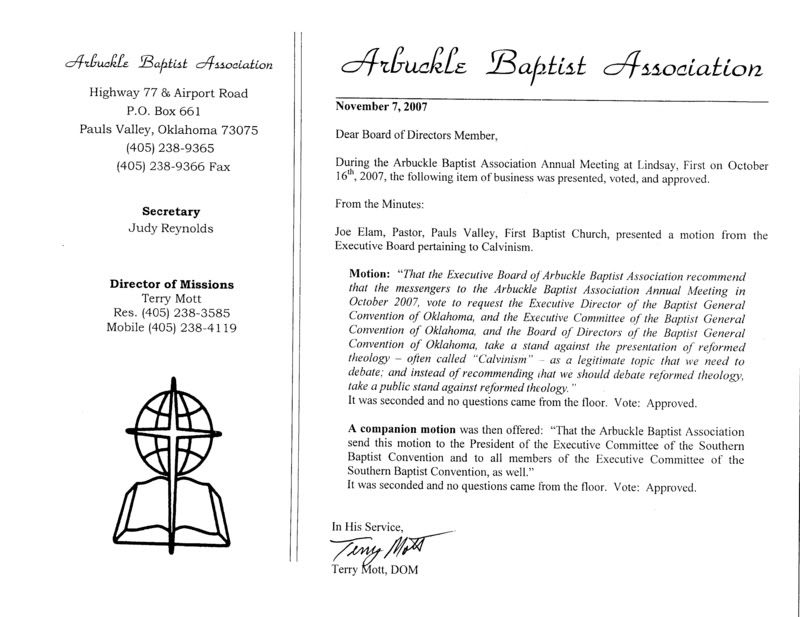
    The irony is overwhelming. Calvinists are described as a lot of things. Arrogance is quite common. Yet I just now saw this posted on Tom Ascol's Founder's Blog. The Arbuckle Baptist Association in Oklahoma has motioned for the Convention to "take a stand against the presentation of reformed theology--often called "Calvinism"-- as a legitimate topic that we need to debate; and instead of recommending that we should debate reformed theology, take a public stand against reformed theology."

    Notice these open-minded men are not even willing to discuss the differing positions as brothers. Many seem to presume that Calvinism is heretical even though I am willing to bet that these people do not even know what reformed theology is. I can't even count how many anti-Calvinism sermons I have heard, much less the average personal conversations I have had, where people claimed to know what Calvinism is, actually didn't!

    Are these people totally unaware of the history Calvinism has had in Baptist life (read Baptist Confessions 1644, 1689, 1742)? Perhaps they are not aware of the fact that the NH 1833 Confession was written so that Calvinists and non-Calvinists could work together? Are these people even aware that doctrines such as the Penal Substitutionary Atonement belongs consistently and squarely in the Reformed/Calvinistic camp? Did not Luther and Calvin defend Justification (with its imputation aspects) within the Lutheran/Reformed Theological frameworks.

    I find it strange for people to proceed to tell me what I believe and then describe something completely foreign to me. I find it odd that many Baptists find no need to defend their Traditions simply because they do not believe they even have them. So now we have an entire Baptist organization demanding that their beliefs go unchallenged. Dialogue, why bother? The irony indeed!

    Saturday, November 17, 2007

    Amazing Grace

    Amazing Grace is perhaps not your fast paced shoot'em up Arnold movies that I like to watch when I am emptying my brain into fantasy land, but it is a movie that is quite moving nevertheless.

    William Wilberforce was certainly a man with flaws, yet by the grace of God he perseveres to accomplish the unthinkable, the Abolition of the Slave Trade. I am not certain Wilberforce's character is true to how he actually was in real life. What I did enjoy is the struggle to persevere when all seemed to fail. When he was about to give up, when all his friends advised him to allow someone younger to take up the cause, he found the faith to remain true.

    I think the movie did well at showing that one need not see the actual terrors of slavery but instead to rely on the information given by eye witnesses. It placed us along side Wilberforce in having to think about the morality of something we may have not experienced. It reminded us that when we pray and attempt to help the persecuted church (for instance), we ought to do so as if we were suffering as well. Wilberforce simply heard about a mother/daughter crying out to "King Wilberforce" in a foreign land to be reminded what his solemn duty before God was. Perhaps a little history lesson of great men of the past will remind us of our need for integrity in the future.

    OK, I am a terrible movie reviewer. I shouldn't have started. I'll end with this. Go buy the movie and enjoy it.

    Its Supply and Demand Silly

    It seems strange to me. He said, "The government needs to get out of our lives. They screw up everything with their bureaucracy." This was in reference to taxes and policy. Recently he complained about the price of oil. "The government better put a stop to this or the economy will have problems."

    OK, I just don't get it. Why do people see the government as a problem and then see it as the solution to the problems the create? How many times do I need to explain the law of supply and demand? Anyway, I thought Rush's monologue about the oil industry was excellent. You may read the entire transcript here.

    Let me tell you how the Democrats and the American left look at this energy business. The thing that you have to understand is, it ain't about America. All this talk about alternative energy and hybrids, that's not about making America better. All this talk and conversation is not about making America cleaner. The way they think: power votes, getting as many people in their base to vote for them as possible, as many independents. By keeping the oil that we have, that we could drill and would decrease dependence on foreign oil. By keeping our oil in the ground and untapped, they become heroes to the environmentalist wackos. Then when the shortages, the necessity to import and that suppression of supply is depressed, what happens to price? Look at the price of oil now. Some of it's speculation; some of it's supply and demand. The price is going to continue to go up. And what happens then? When the low supply, the artificially low supply -- there needn't be a low supply given our reserves that are untapped -- that low supply drives up the price, they become the heroes of the poor and the freezing. How do they do that? Because they then attack Big Oil for gouging. And, of course, everybody hates Big Oil, just like they hate the boss.

    So you've got people in the Northeast who use home heating oil and the price is going up because we've got an artificially depressed supply, thanks to Democrats. Those people have to pay through the roof for their heating oil, and the Democrats become their champions. They don't solve any problem unless Hugo Chavez comes to the rescue and sells it cheap. So the very people that are causing rising prices benefit twice from causing it. A, the environmentalist wackos love them and give them lots of money, and B, the poor, the hungry, the thirsty, the freezing, think the Democrats are the ones standing up for them. That's the way they look at it. They're not interested in improving America's lot in the world, particularly not when a Republican is in the White House.

    In the end, Democrats place themselves in a win/win situation. Simple economic education ought to fix such things. Perhaps I am being overly simplistic in my little mind?

    Friday, November 16, 2007

    Anyone Want To Be President?


    Normally I would say that Democrats are guilty of following the Socialism of Europe, yet I simply do not hear anyone, Republican or Democrat, speaking of the greatness of our own ideals that has made America great. After listening to much of this speech I simply have to wonder if there is anyone wanting to be President of the U.S.. Whoever speaks like this man will gain the American populace. It is to bad that a Frenchman has to remind Americans of what America is about.