Sunday, February 12, 2012

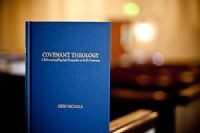
Covenant Theology by Greg Nichols

Well, I am finally half way through Greg Nichols book, Covenant Theology: A Reformed and Baptistic Perspective On God's Covenants. As the Preface states,


This book stems from systematic theology lectures. Christology covers the eternal plan, the solemn promise, and accomplishment of salvation. God expresses his solemn promise of salvation in his covenants.

The first half of the book surveys Reformed Theologians/Theology such as the Westminster and London Confessions, John Gill, Charles Hodge, Robert Lewis Dabney, the Dutch Calvinists and contemporary modifications. This is extremely helpful for Nichols shows the many insights and contributions each have given to this area, but Nichols is also honest in demonstrating some of their weaknesses as well.

For instance, early in the book, Nichols asks a question that he asks all of his students in his classes and offers a chart of the possible ways to see this in a chart on page 12. He explains a potential problem between the Westminster Confession and the Larger Catechism question 31 when we try to distinguish between the essence/substance verses the implementation of God's Covenant of Grace. He quotes the London Baptist Confession 7:2.

...a covenant of grace, wherein he freely offereth unto sinners life and salvation by Jesus Christ, requiring of them faith in him, that they may be saved; and promising to give unto all those that are ordained unto eternal life, his Holy Spirit, to make them willing and able to believe.

To which he then leads his students in a series of questions as to the nature and application of the covenant of grace.

What is the promise? And someone says, life and salvation by Jesus Christ....Now who are the partakers? To whom is this promise made? And now another student says, sinners. Correct. And so I ask, what is the condition? What does God require sinners do to be saved? And the class answers, believe, have faith. It says, "requiring of them faith in Him."

Now follow his train of thought here in his next questions.

Then I ask, are these sinners converted or unconverted?

Of course the class inevitably answers unconverted because of the command that they must believe.

To which he responds:

So then, the partakers are lost sinners indiscriminately, all unconverted persons who hear the Gospel. Thus if this defines the essence of the covenant of grace, then it would be a conditional covenant between God and unconverted sinners.

Now here is where things get a little tricky when he deals with the effectual call.

What is the promise?

To which the students respond.
promising to give unto all those that are ordained unto eternal life, his Holy Spirit, to make them willing and able to believe.

Now who are the partakers? Obviously this would be God's elect. So what does God require of the elect? What does He require them to do?

Nothing.

To which Nichols responds to his students,

Then it's unconditional...So then someone has to admit, the elect are viewed as unconverted, and it says that God promises the unregenerate elect that he will give them his Holy Spirit to make them willing and able to believe....

Now if you see the problem then you have a sharp mind, but if you don't then let me cite Nichols again from page 12.

So now I say to the class, does this define the essence of a covenant between God and His people? Now, not reluctantly, but emphatically, and usually a little shocked, they affirm that it does not.

Nichols uses this approach in order to help the reader understand those whom he surveys. It becomes obvious when Nichols interacts with Hodge and Gill and the others that they also saw this problem in their attempts to provide a sound covenant theology. As he concludes in his chapter, Summary of the Classic Reformed Doctrine,

The general and effectual call should not be regarded as distinct expressions of divine covenant. Rather, God, in His inscrutable wisdom, has determined to fulfill His covenant of grace, His pledge to apply redemption to His elect, through the general ad effectual call of the gospel, not in isolation, but in combination. Thus, it is not the hearers of the gospel who partake in this divine covenant, but the receivers and doers of the gospel, who obey the gospel in repentance and faith.

Therefore we must keep the means and essence of the covenant distinct when seeing how we define the covenant of grace.

Thursday, February 02, 2012

God Saw Obama Care, and It Was Very Good

UPDATE:

This gets even better. Apparently, God wants everyone to have access to contraception. Read here.

-------------

So God made President Obama pass Obama Care. As this story from Buzzfeed reports,

"And so when I talk about our financial institutions playing by the same rules as folks on Main Street, when I talk about making sure insurance companies aren’t discriminating against those who are already sick, or making sure that unscrupulous lenders aren’t taking advantage of the most vulnerable among us, I do so because I genuinely believe it will make the economy stronger for everybody. But I also do it because I know that far too many neighbors in our country have been hurt and treated unfairly over the last few years, and I believe in God’s command to 'love thy neighbor as thyself.'"

So there you have it. Love Thy Neighbor is now equivocated to forcing your neighbor by the barrel of a gun to pay for your health care. This same man, who has won the Nobel Peace Prize, has also loved his neighbors with bombs. Neighbors that we are not even at war!

Now to be fair, we are all moved by our religious beliefs, and those beliefs animate us in the public sphere. Fair enough. However, keep in mind, it is the Left that constantly makes fun of this kind of reasoning. Think of abortion. I am moved by a simple belief that abortion is murder. It also happens to be fundamental in my religious beliefs that the unborn are fully human persons. Yet isn't it the Political Left that argues I should keep my religious beliefs out of the public sphere?

The hypocrisy shines ever so brightly with this man.

Sunday, January 29, 2012

Riding At the Cat House

On a more personal note, my daughter and I decided to do some riding at a place we've never been before, known as the Cat House. It is a little place north of Dighton, KS and just north-east of Shields, KS [3 miles east and 3 north], which is basically the middle of nowhere near the Smokey Hills.


I have never ridden there mainly because I didn't know much about it, and it costs $20 per day per person. That is a big turn off factor, but the membership fee is even more amazing. I won't bother to tell you. Now to be fair, the membership fee is probably fair if you camp a lot. However, since I just want to ride a couple of days a year, I just can't see spending that much money.

Well, today, I spent the $20 and went with my daughter (he didn't charge for her today). Now I must say I was pleasantly surprised. It truly is a little hidden oasis for dirt bike riders. Now there were several campers there. So if you like camping in a desert looking place with no trees, I guess this would be your place as well. Plenty of fishing too!

Here is a picture of Rachel.


Now the negative, which may be a positive, was that there were not really any motorcycle trails per se. I basically rode anywhere I wanted. The draw back was that I had to be very cautious where I went. At one point I climbed a very steep hill only to stop as my tire hit the peak. You see, there was no top. It was literally a peak with a sheer cliff on the other side. So I had to do the skiing thing to get back down. Therefore, I needed to spend much of the day scouting what I could really ride.


However, this was also an advantage. I could literally climb all kinds of slopes, (yes, I said slopes in Western KS!) some of which had been cimbed many times,while others maybe not so much?

Now I don't want to make myself sound like a pro-rider. I am not by any means. But if you want a good work out and you live in western Kansas, and you don't mind losing $20 to ride one day, you may just enjoy yourself.

Sunday, January 08, 2012

Have You Prayed About Your Faith's Truth?

Yesterday I was visited once again by our local LDS, Mormon missionaries. Of course the two elders that stopped by were another two that I had not met before since they constantly rotate them. The conversation was very good, and to their credit, the young men tolerated me.

The conversation was typical. They started by asking me what I believed. Then they proposed their view about Joseph Smith being a modern prophet and that the priesthood has been re-established. Then came the famous question, "Have you prayed about the Book of Mormon?"

It fascinates me to no end that people place religious truth into an entirely different category of knowledge. As I commented last July in a post about that very issue (read here), we place religious truth in a merely experiential arena of knowledge. So when I ask the LDS missionaries about praying whether or not Roman Catholicism being the true church or the Methodists or the Watch Tower or a Hindu church or an Islamic church, and I get a warm fuzzy feeling telling me that one of those churches are the one true church, they simply revert back to praying for the heart burn feeling of confirmation, even though that heart burn feeling might be from having too many enchiladas for lunch.

Any time I appealed to the Bible, they used the old "That is your interpretation verses another interpretation" argument. Now of course, that is an argument that presupposes that the New Testament is unclear. This of course means God can't speak clearly. Now it begs the question. How do we know we are interpreting the Book of Mormon correctly, or Joseph Smith for that matter? Is God really unable to speak as clearly as Joseph Smith?

I decided to bring up the passages of Scripture that challenge this false presupposition. Here are a few of them. Deuteronomy 13:

1 If a prophet, or one who foretells by dreams, appears among you and announces to you a sign or wonder, 2 and if the sign or wonder spoken of takes place, and the prophet says, “Let us follow other gods” (gods you have not known) “and let us worship them,” 3 you must not listen to the words of that prophet or dreamer. The LORD your God is testing you to find out whether you love him with all your heart and with all your soul. 4 It is the LORD your God you must follow, and him you must revere. Keep his commands and obey him; serve him and hold fast to him.

Where in Moses' teaching does Moses place knowledge in the mere esoteric category? Does Moses teach that we should pray about the Book of Mormon? The passage is quite clear. We are to test what prophets teach against the Revelation God has already given through Moses.

Of course, you will say, "How do I know Moses is a true prophet?" The answer is quite simple. The Revelation Moses gave was not in some secret room. Instead, God invaded history with all kinds of signs, not the least of which was the Crossing of the Red Sea. Perhaps if Joseph Smith parted the Missouri or Mississippi River, the LDS missionaries might have something to stand on.

In the New Testament, the Gospel according to Luke starts wit this:

1 Many have undertaken to draw up an account of the things that have been fulfilled[a] among us, 2 just as they were handed down to us by those who from the first were eyewitnesses and servants of the word. 3 With this in mind, since I myself have carefully investigated everything from the beginning, I too decided to write an orderly account for you, most excellent Theophilus, 4 so that you may know the certainty of the things you have been taught.

Where does Luke say something that would teach we should pray about his Gospel? Nowhere! Instead, Luke appeals to historical events that he personally has investigate and confirmed by eye-witnesses in order that Theophilus could have certainty outside of himself, a certainty that would not be based in some esoteric religious experience but a certainty that would be based squarely in the world in which we normally live.

Paul's charge to Timothy contains a most sufficient passage. 2 Timothy 3:

But as for you, continue in what you have learned and have become convinced of, because you know those from whom you learned it, 15 and how from infancy you have known the Holy Scriptures, which are able to make you wise for salvation through faith in Christ Jesus. 16 All Scripture is God-breathed and is useful for teaching, rebuking, correcting and training in righteousness, 17 so that the servant of God may be thoroughly equipped for every good work.

This passage is quite clear. Scripture is sufficient. We do not need another supposed God-breathed source. But could there be another source? One last passage from the writer to the Hebrew Christians chapter 1:

1 In the past God spoke to our ancestors through the prophets at many times and in various ways, 2 but in these last days he has spoken to us by his Son, whom he appointed heir of all things, and through whom also he made the universe.

In these last days we have the full Revelation of God in the Person and Work of the Son of God. There is simply no need to go any further. There is no need for other prophets of other revelatory sources. We have all we need in Jesus Christ and His Apostles as preserved in the Apostolic writings in the New Testament and the Hebrew Scriptures.

In conclusion I think more passages could be presented, but I think it should suffice in these brief arguments that searching for truth through esoteric means is one Christians need to learn to be consistent within their worldview and evangelical missionary endeavors. If we believe Mormons are wrong simply on the level of "praying about the Book of Mormon", then we should not attempt to evangelize using similar means.

However, if we agree with their esoteric viewpoint, then we have no basis for evangelizing people to come to our faith. Of course this may explain why so many Christians accept the false premise of Mormonism being just another Christian faith. But Mono-Theism, by definition, can never be compatible with Poly-theism, no matter how esoteric one gets.

Tuesday, January 03, 2012

Theology Matters

[I wrote this post originally for the Tea Party Hobos blog simply because it is more political, especially in defense of a political candidate, but since I think some of the issues raised by Michelle Goldberg have discussed on this blog in principle, I thought it worth posting here as well.]

Bill Anderson wrote a brief post on Lew Rockwell's blog this morning. Now I have noticed several statements that, though, I bet they do know the reasons for certain quasi-religious claims, the contributors of the blog seem to hide their knowledge in an attempt not to get into overly religious discussions on a political site.


First Bill quotes a Leftist, Daily Beast's, Michelle Goldberg:
It might seem that Paul’s libertarianism is the very opposite of theocracy, but that’s true only if you want to impose theocracy at the federal level. In general, Christian Reconstructionists favor a radically decentralized society, with communities ruled by male religious patriarchs. Freed from the power of the Supreme Court and the federal government, they believe that local governments could adopt official religions and enforce biblical law.
To which Bill responds by saying,
So-called biblical law would require stoning of gays and other measures that would mirror the Taliban, she writes. (Not surprisingly, Goldberg misrepresents both Covenant Theology and the diversity of opinion of people who fall under that theological umbrella.) So there you have it: Ron Paul's libertarianism is going to create a new American Taliban. Look for more of this kind of nonsense as clueless mainstream reporters try to write about someone who does not believe the State should be an object of worship.
Bill is absolutely right. Covenant Theology is very able to answer the objection by the Left's thinking concerning religious people wanting to establish some kind of Theocracy, but some seem to overlook that Covenant Theology is only now coming back into popularity in mainstream Evangelicalism.


Dispensationalism has been the popularized eschatology and theological framework for quite some time. It is Dispensationalism that has led many to favor the nation of Israel as if they were God's modern day people and theocracy. Of course, since Dispensationalism's utter predictive failure of Christ's Second Coming through date setting schemes, Dispensationalism is waning. But I think it might explain some of the statements on LRC.


As a Christian, I recognize "theology matters". It greatly impacts life and culture. Good theology does so in a good way. Poor theology does so in a poor way. So when women like Michelle Goldberg misunderstand (purposeful or not) politically active Christians, I am not convinced it is entirely her fault. Yet after trying to explain sound theology to people such as Michelle Goldberg, it is my experience she has no intention of trying to understand. She fears that without Central Planning from the Federal Government, the homosexual agenda will not go forth. And of course, as one who has embraced Libertarianism to an extent as a Christian, I have made that exact same argument. She is quite right for seeing Libertarianism's stress on private property rights as something to fear.


In other words, the easiest way to stop the culture war and/or win it from a conservative perspective is to restore private property rights. Then people are free to be who they are, and that includes being able to discriminate with your property. That is something, I think, Michelle fears far more than anything else.


Now she does mischaracterize Covenant Theology when she wrote,

In fact, they’re often much further to the right. While dispensationalists believe that Christ will return imminently and establish a biblical reign on earth, covenant theologians tend to believe its man’s job to create Christ’s kingdom before he comes back. The most radical faction of covenant theology is called Christian Reconstructionism, a movement founded by R. J. Rushdoony that seeks to turn the book of Leviticus into law, imposing the death penalty for gay people, blasphemers, unchaste women, and myriad other sinners.

Covenant Theology does no such thing. What I think she is referring to is a position called Theonomy. Theonomists are usually under the umbrella of Covenant Theology, but is in fact, an eschatological position based squarely in Post-Millenialism, and she may very well be right in linking this with an American version of Christian Nationalism. However, even its modern proponents such as Greg Bahnsen saw that Old Testament laws as cited by Michelle were problematic and that far more work needed to be done in this area.

In conclusion, the arguments provided by Michelle are in my opinion emotional and fear-mongering. She admits that she is taking the fact that her argument is based upon the "fundamentalist faction that has until now been considered a fringe even on the Christian right" and that this position is a small minority among those who are Ron Paul supporters.

Ron Paul is a libertarian. Libertarianism and Theonomy are just not compatible.

Monday, December 26, 2011

A Couple of Quick Notes

Two quick notes. First, I thought this brief discussion on preaching by Pastors Cory and Chris I think is a helpful reminder on the importance of God's Revelation and how it is to be handled.


Also, for Christmas I received a book, Covenant Theology: A Reformed and Baptistic Perspective on God's Covenants, by Greg Nichols. As time allows, I am certain I will interact with the book and offer some comments. This book has sold like hot cakes. I think it is for the simple reason as stated by one endorsement.

I am not aware of anything in print that treats this topic as clearly and comprehensively, and from a distinctly Baptistic perspective. -- Pastor Jim Domm
Personally, the only book that I have that treats this topic is from the same perspective is by Nehemiah Coxe, a particular Baptist of the 17th century. This book I think fills a giant void in the modern life of Baptists, who desire to be consistent in their theology.

Friday, December 16, 2011

Hitchens and the Meaning of Christmas

Today is truly a sad day for National Public Radio, NPR, for one of their favorite God-hating atheists has died. On the other hand, it is truly a sad day for those who have prayed for this God-hating atheist, for this atheist has come before the Judge of all the Earth.

Of course, I am speaking of Christopher Hitchens. And as usual, these things seem to happen quite a bit near Christmas time. Nearly 20 years ago my own grandfather died on the same day. And quite similarly, he died (to my knowledge) apart from the Savior and the people that Savior has gathered to Himself.

Since so many are talking about Hitchens' death this morning you might ask, "Why bring this up?" I'm just one more voice in the world saying the same thing that other Christians are saying. That's true. I am just one more voice. But just as Christopher Hitchens was one voice among many for atheism, I am one voice among many that Christ has called to go into the world to proclaim "Good News".

So what is that Good News? Well, as we celebrate this holiday season, as one of many Christians in the world, I simply wish to remind the reader in this post why Christians celebrate Christmas. It is as Linus says in the Charlie Brown Christmas special:

And there were in the same country shepherds abiding in the field, keeping watch over their flock by night. And, lo, the angel of the Lord came upon them, and the glory of the Lord shone round about them: and they were sore afraid. And the angel said unto them, Fear not: for, behold, I bring you good tidings of great joy, which shall be to all people. For unto you is born this day in the city of David a Saviour, which is Christ the Lord.
So this Christmas, let us remember that like Christopher Hitchens or your own grandfather, you are going to have the same end. And like them, we need a Savior above all else. Christ, the Son of God, has come into the world. Will you come to him this Christmas?

Friday, December 09, 2011

Conception to birth visualized - Alexander Tsiaras

This video on the development of babies is simply amazing.

Friday, November 25, 2011

Merry Christmas Trees & the Second Commandment

Sooner or later, I know the "Should we have a Christmas Tree?" conversation will inevitably come up. So I am going to get it out of the way now. My conclusion will be stated right up front. Christians may in fact be wrong for having Christmas trees. There I said it. But hold on....

Now in reality, I don't really care, but I am one that strives for consistency. So when my Jehovah's Witness friend comes over, I know in his mind, as he stares at the evil tree in my living room, he is thinking that the Watch Tower is right. I'm just a pagan. But I am not going to go out of the way and eliminate a cultural decoration simply because some JW thinks I am a pagan.

However, one could argue that, just as we go out of our way for our conscious stricken brothers over alcohol, we should go out of our way to not unnecessarily offend a JW. True enough. But if I did that, there would literally be no end. I would probably have to live at the bottom of the ocean in order to become acceptable to everyone.

Another argument that has come to my mind is the fact that I have argued against using improper means to get people to "experience Christ". Are we using the tree to get people to hear the Gospel and feel closer to the Lord? Again, I think this is where the Christian must be careful. In my opinion, Christmas Trees and other artful things are just that, cultural icons. If we use them as spring boards into Gospel conversations, then I'm not seeing the connection. However, if I have to gather my family and friends around a tree in order to feel more worshipful, then I am indeed being inconsistent.

The New Testament is clear about worship. We have the physical experiences we need in Baptism and the Lord's Table as instituted by Jesus Himself. Yet I am not convinced that Christmas Trees are necessarily something that cause us to violate the Second Commandment. If so, then many of the Old Testament icons such as the Ark of the Covenant would be problematic. Of course, those were provided by God. Christmas Trees were not.

So basically, my initially stated conclusion may be correct. It just depends on what we mean to do with Christmas Trees. As for now, I'll still set one up. My kids enjoy the season. They get gifts. Isn't that why we do this in the first place? To teach the importance of giving and the anticipation of receiving something wonderful? Hmmmm, but are we back to that experience argument again? I don't think so. My kids experience all kinds of things from me. If some of that helps them to find Christ, the supposed inconsistency becomes invalid.

So Merry Christmas, and if your conscience allows, let your kids open those gifts placed around that tree. Just don't look to it with prayer and worship. It's just a tree.